AUTUMN EXPO STEPHANE NOËL photographer
16 September – 11 December 2017
Stephane Noël
Stéphane is a contemporary photographer whose works have propelled him to the forefront of the scene of photography.
Stéphane is mentioned by connoisseurs in the same breath as famous photographers as Sebastião Salgado, Joseph Koudelka, Henri Cartier-Bresson and Andre Kertész.
After his works have been exhibited in Budapest, Arles, Milan, London, Paris, Warsaw, Holland, Spain and Germany, his international breakthrough was a fact. The leading Dutch magazine “fotografie” praised his work in a 10-page article.
His artworks are now booming and becoming a huge investment for contemporary art collectors because they expect prices will rocket.
Meanwhile, key players in the photography market & museums worldwide are discovering him and they are lining up to organize expositions with Stéphane.
The famous curator in the scene of photography, Veronica Besnier, picked up on Stéphane Noel. Fascinated by his work, she is now negotiating shows for him in Latin America.
The curator already organized exhibitions with the world’s most famous photographers, worked together with the Magnum Agency, the Cartier Bresson Foundation and the french editor Xavier Barral.
On Veronica’s curriculum we find -amongst others- great exhibitions with Robert Doisneau, Elliot Erwitt, Robert Frank, Robert Capa, André Kertész and Sebastião Salgado. Works of these artists have been auctioned for up to $100,000.
On the schedule of Stéphane Noel are new exhibitions at the Museo Nacional de Bellas Artes in Santiago de Chile, in Budapest, Berlin, Warsaw and others.
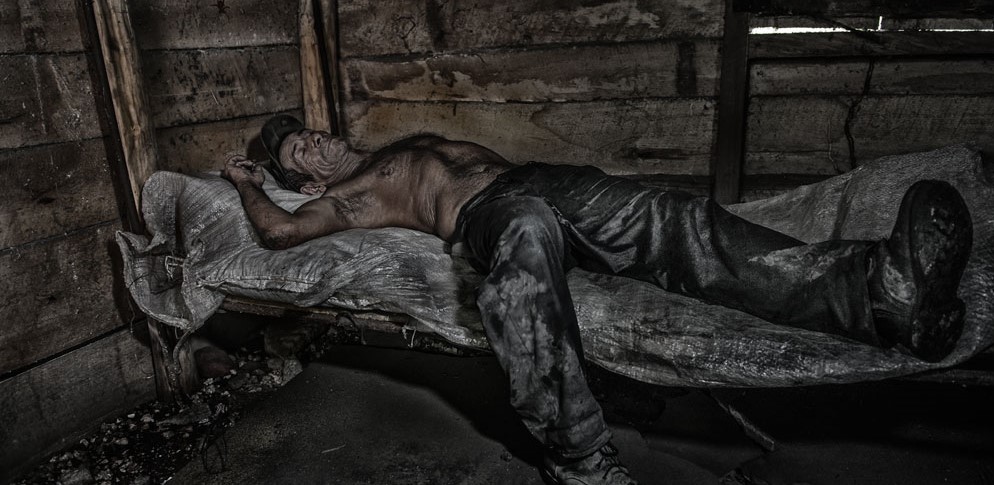
Stéphane No?½l has always needed to discover and understand the others to make sense in his life, to explore the human being and to find answers about himself as well. Photography gives him the entrance to the unknown, like a passport that opens doors.
Constantly searching for a kind of truth, he spends a long time listening, observing, learning, feeling… unconsciously it appears that most of his projects are about the “end” of something: the world, the life, professions, ethnicities, relations… and then another question comes, what’s next?
To be able to express himself till the last step of his approach, he chooses an ancient way of printing known from the middle of the 19th century, called gum bichromate. This multi-layer traditional hand-crafted technique gives him the possibility to make his own interpretation of each of his prints, which makes each of them unique.
Sa démarche artistique
Ses projets se déroulent, en général, en trois étapes :
En premier, il y a la rencontre, il passe beaucoup de temps à écouter, partager, expliquer sa présence. L’appareil photo n’est alors qu’une sorte de passeport, de visa, de prétexte pour aller à la rencontre de l’autre. Pour lui, c’est un peu comme une thérapie personnelle pour apprendre d’autres cultures, d’autres vies et probablement aussi pour mieux se comprendre lui-même. Lors d’un premier voyage, il ne fait pas ou très peu de photos. Une vraie relation de confiance et de respect de part et d’autre doit s’installer petit à petit.
Dans un second temps, vient la prise de vue. Etant donné la relation instaurée préalablement, il reçoit en général beaucoup. Ayant travaillé longtemps au moyen format argentique, il a gardé l’habitude de ne pas ‘mitrailler’. Il fait très peu de photos, il est plus à la recherche de l’émotion, d’un partage honnête et sincère, d’une vérité qu’il obtient plus par le dialogue, l’échange de regard, l’ouverture et le respect quand ‘shootant’ en rafale caché derrière son boitier. Il a constaté avec le temps, que ça met souvent mal à l’aise et empêche les gens de se livrer. Les gens jouent plus un r??le et ne sont plus eux mêmes. Pour les mêmes raisons, il voyage très souvent seul, sans équipe, assistant ou matériel ‘spectaculaire’. Il veut aller au-delà de la perfection technique, il veut l’émotion, estimant que chaque être est unique, avec les traces de son propre vécu, son ?óme et son cœur.
Enfin, troisièmement, le tirage… Dans la plupart des cas, il tire ses photos à la gomme bichromatée (technique d’impression par contact en plusieurs couches, procédé pigmentaire datant du milieu du 19ème siècle) qu’il a un peu adaptée par rapport à ses besoins. Mis à part les qualités de stabilité incomparable de ce procédé et le caractère unique de chaque tirage (impossible à reproduire à l’identique), il a fait ce choix car il aime prendre le temps d’aller au bout des choses. Dans son cas, il peut travailler jusqu’à une dizaine de jours pour réaliser un tirage. Par amour pour les matières, le toucher, cette méthode artisanale lui permet de réellement interpréter les tirages suivant les émotions et les sensations ressenties. C’est le meilleur moyen qu’il ait trouvé pour pouvoir s’exprimer.